Lucca: history and what to see
A city in layers
Lucca is just twenty minutes down the hill from La Limonaia. It is small enough to cross on foot. Yet you can still walk its Roman street plan, medieval lanes and Renaissance walls.
Lucca kept its freedom far longer than its big Tuscan neighbors. Florence, Pisa and Siena lost theirs centuries before Napoleon arrived. Lucca was still a free republic in 1805. Follow the dates below to see how each age shaped the city, and where its traces survive.
- Roman colony
- 180 BC
- Independent
- Until 1805
- Wall circuit
- 4.2 km
- From the house
- 20 minutes
Before 180 BC
Before Rome
Wet ground, a borrowed name and two peoples at the edge of Tuscany.
The Etruscans settled the Serchio plain, while Ligurian tribes lived nearby. Both peoples were here before Rome arrived. The name Lucca may come from a Ligurian or Celtic word for marshy ground. That fits the damp plain between the Serchio and the now-vanished Auser river. The Romans adapted the existing name to Luca.
180 BC–5th century
Roman Luca
The street plan you walk today began as a Roman military grid.
Rome founded the colony of Luca in 180 BC, on its frontier with Liguria. In 89 BC, its residents became Roman citizens. The army laid out the town as a grid of streets crossing at right angles. That grid survives in the northern half of the old town. Via Fillungo follows the main north–south street, and Piazza San Michele occupies the old forum.
The other great Roman survival is a shape. A second-century amphitheater outside the walls was quarried for stone and built over, but medieval houses followed its curve. The ellipse survives as Piazza dell’Anfiteatro, about three meters above the original arena floor.
Luca also has a walk-on part in the collapse of the Roman Republic. In 56 BC, Julius Caesar, Pompey and Crassus met here to patch up the First Triumvirate. Luca sat inside Cisalpine Gaul, the province Caesar governed, so he could meet his rivals without leaving his command.
c. 570–1115
An Early Medieval Capital
For roughly 200 years, Lucca, not Florence, was the center of Tuscany.
From the late sixth century, Lombard rulers made Lucca the capital of Tuscia, a territory covering much of Tuscany. They also began the mint that produced Luccan coins, with interruptions, until 1843.
Charlemagne conquered the Lombards in 774. Frankish margraves replaced the dukes but kept Lucca as their capital. The Via Francigena pilgrimage road passed through the city. Archbishop Sigeric recorded Lucca as a stop on his journey to Rome in AD 990.
Pilgrims came to see the Volto Santo, or Holy Face. It is a life-size wooden crucifix showing Christ in a robe. Legend said Nicodemus carved it. Modern tests date the surviving sculpture to about 770–880. This makes it one of the oldest wooden sculptures in the West. Lucca still honors it with a candlelit procession every 13 September.
1115–1369
Silk, Coin & Towers
Trade paid for independence, and merchant wealth remade the skyline.
When Matilda of Canossa died in 1115, Lucca seized the chance to govern itself. The city bought the remaining feudal rights in 1160. Emperor Frederick Barbarossa confirmed its self-government two years later.
Silk paid for that freedom. From the eleventh century, Lucca built western Europe’s first major silk industry. Its damasks and gold-thread brocades reached French fairs and the papal court. Lucchese merchants also ran banks in Bruges, Paris and London.
Merchant wealth rose into the skyline. Families built tower-houses as strongrooms and symbols of status. Sources disagree on how many stood at once, but there were dozens. Most were shortened in the sixteenth century. Torre Guinigi survived.
Pisa seized Lucca in 1314. The mercenary commander Castruccio Castracani then turned it into a regional military power. After his death, Lucca spent forty years under changing foreign rulers.
1369
The Stubborn Republic
Small, oligarchic and independent while its larger neighbors fell.
In 1369, Lucca bought its freedom back from Emperor Charles IV. The restored republic would remain independent until Napoleon ended it in 1805.
Paolo Guinigi ruled as lord from 1400 until citizens arrested him in 1430. Afterwards, a small circle of wealthy families controlled the republic. A council of elders, the Anziani, governed under a chief official called the Gonfaloniere. Their terms lasted only weeks, limiting any one person’s power.
Lucca stayed safe by avoiding open fights. It stopped trying to gain more land, paid for protection and spent money on talks and strong walls. Its motto was one word: Libertas, meaning freedom.
1504–1648
A Fortress That Became a Park
The republic’s greatest defense was never attacked.
Lucca already had Roman and medieval walls when the republic began a new circuit on 7 May 1504. Building lasted until 1648. The finished ring measured 4,223 meters and stood about 12 meters high. Eleven arrow-shaped bastions and thick earth banks absorbed cannon fire.
No army ever tested these defenses. Today the complete circuit survives, making it one of the clearest places to understand the republic’s caution and wealth.
1805–1814
Elisa Bonaparte’s Principality
Napoleon ended the republic and handed Lucca to his eldest sister.
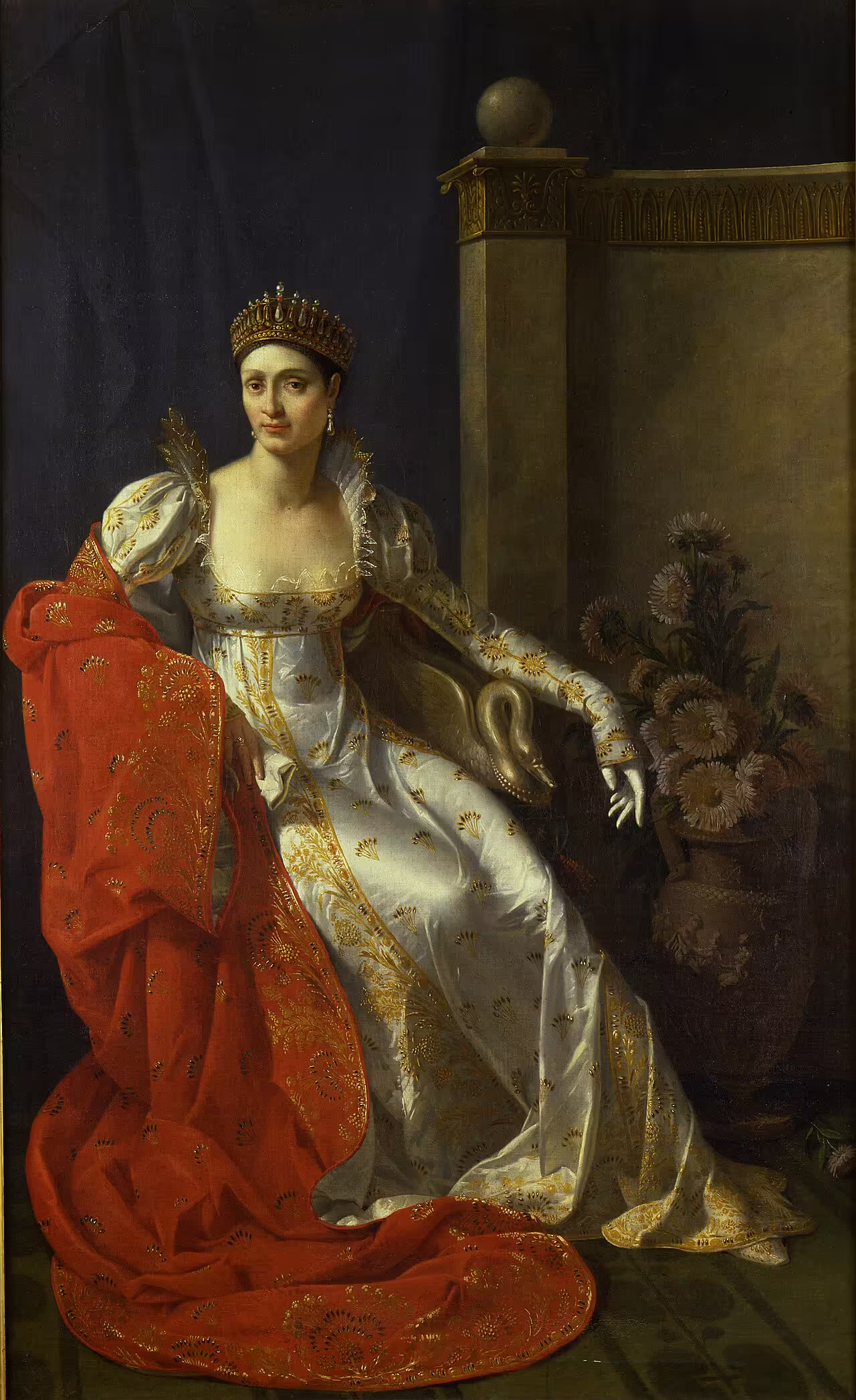
French troops occupied Lucca in 1799. Six years later, Napoleon ended the republic and joined Lucca with Piombino. He gave the new principality to his sister Elisa and her husband Felice.
In 1812, the walls faced water instead of an army. When the Serchio flooded, residents blocked the gates with mattresses and straw. The walls kept the city dry.
Elisa was the stronger ruler. She reorganized the silk industry, controlled the Carrara marble quarries, built roads and closed monasteries. She also cleared buildings in front of Palazzo Ducale to create Piazza Napoleone. Nine years of rule gave Lucca a French-style administration and a very good square. Her country residence at Marlia is the centrepiece of our guide to Lucca’s villas and gardens.
1815–1861
Duchy & Kingdom
Lucca lost its republic but gained much of its nineteenth-century face.
The Congress of Vienna created the Duchy of Lucca for Maria Luisa di Borbone, a Spanish Bourbon princess. During her reign, Lucca gained the botanical garden and Lorenzo Nottolini’s aqueduct. In the 1820s, she also planted the walls with trees and opened them as a public promenade. Nottolini reshaped Piazza dell’Anfiteatro into the ellipse seen today.
Lucca joined the Grand Duchy of Tuscany in 1847. Tuscany then joined the Kingdom of Sardinia in 1860, followed by the new Kingdom of Italy in 1861. After seven centuries, Lucca no longer ran its own affairs.
1861–today
War, Tourism & Puccini
The walls and a largely car-free center helped the old city survive intact.
Giacomo Puccini was born in Lucca in 1858, into a family of cathedral musicians. He moved to Torre del Lago in 1891. There he wrote most of his famous operas, and he is buried inside his villa.
Industry replaced some of the wealth once made from silk. Paper mills and olive oil became important. Then war reached the province. On 12 August 1944, SS troops murdered about 560 civilians at Sant’Anna di Stazzema. Lucca itself escaped major destruction. Partisans entered first, followed by the American 92nd Infantry Division on 5 September.
After the war, Lucca protected its walls and restricted cars in much of the historic center. Tourism now drives the city. The Summer Festival fills Piazza Napoleone in July, while Lucca Comics & Games takes over the center in late October.
A 3–4 hour first visit
Walk It Yourself
- Park at Parcheggio Mazzini. Use the entrance on Via dei Bacchettoni, then set off on foot into the historic center.
- The walls. Take the nearby ramp up, walk the shaded eastern and northern stretch, then descend at Porta Santa Maria.
- Via Fillungo & Piazza dell’Anfiteatro. Follow Lucca’s old Roman spine south and slip through an arch into the amphitheater’s ellipse.
- Torre Guinigi. Cut back through the lanes and climb the 230 steps while your legs are still fresh.
- San Michele in Foro. Continue south-west to the old Roman forum and its exuberant marble church.
- Duomo di San Martino. Finish with the Volto Santo and Ilaria del Carretto. Then find lunch.
If the afternoon is hot, detour through Palazzo Pfanner or the botanical garden. The drive back up to Aquilea takes twenty minutes.
Sources & image credits
Compiled from the English and Italian Wikipedia articles on Lucca, the Walls of Lucca, the Republic of Lucca, Lucca Cathedral, San Michele in Foro, the Volto Santo, the Torre Guinigi, Piazza dell’Anfiteatro, Palazzo Pfanner and Giacomo Puccini; the Encyclopaedia Britannica entry on Lucca; and the tourism and heritage pages of the Comune di Lucca. Where the sources disagree, such as on the number of medieval towers, the text says so rather than picking a figure.
Image Credits
- Piazza dell’Anfiteatro: Wikimedia Commons, Kasa Fue, CC BY-SA 4.0
- Domus Romana Lucca: Wikimedia Commons, Deizenov, CC BY-SA 3.0
- Volto Santo: Wikimedia Commons, Sailko, edited by MenkinAlRire, CC BY-SA 4.0
- Tomb of Ilaria del Carretto: Wikimedia Commons, Photo2023, CC BY 4.0
- The city walls: Wikimedia Commons, Georges Jansoone (JoJan), CC BY-SA 3.0
- Portrait of Elisa Bonaparte: Wikimedia Commons, Marie-Guillemine Benoist, public domain
- San Michele in Foro: Wikimedia Commons, Spike, CC BY-SA 4.0
- Basilica of San Frediano: Wikimedia Commons, Myrabella, CC BY-SA 3.0
- Duomo di San Martino: Wikimedia Commons, Mongolo1984, edited by MenkinAlRire, CC BY-SA 4.0
- Santi Giovanni e Reparata archaeological area: Wikimedia Commons, Zairon, CC BY 4.0
- Torre Guinigi: Wikimedia Commons, Lucarelli, CC BY-SA 3.0
- Via Fillungo: Wikimedia Commons, Palickap, CC BY-SA 4.0
- Palazzo Pfanner garden: Wikimedia Commons, Sailko, CC BY 3.0
- Piazza Napoleone: Wikimedia Commons, L.E.rewi-sor, CC BY-SA 3.0
- Orto Botanico di Lucca: Wikimedia Commons, HauchnebelkabinetT, CC BY-SA 4.0
- Puccini Museum birthplace: Wikimedia Commons, TeKappa, CC BY-SA 4.0
- Villa Puccini at Torre del Lago: Wikimedia Commons, Sailko, CC BY-SA 3.0


,_03-266.jpg)


.jpg)


